
Quantum Cliff
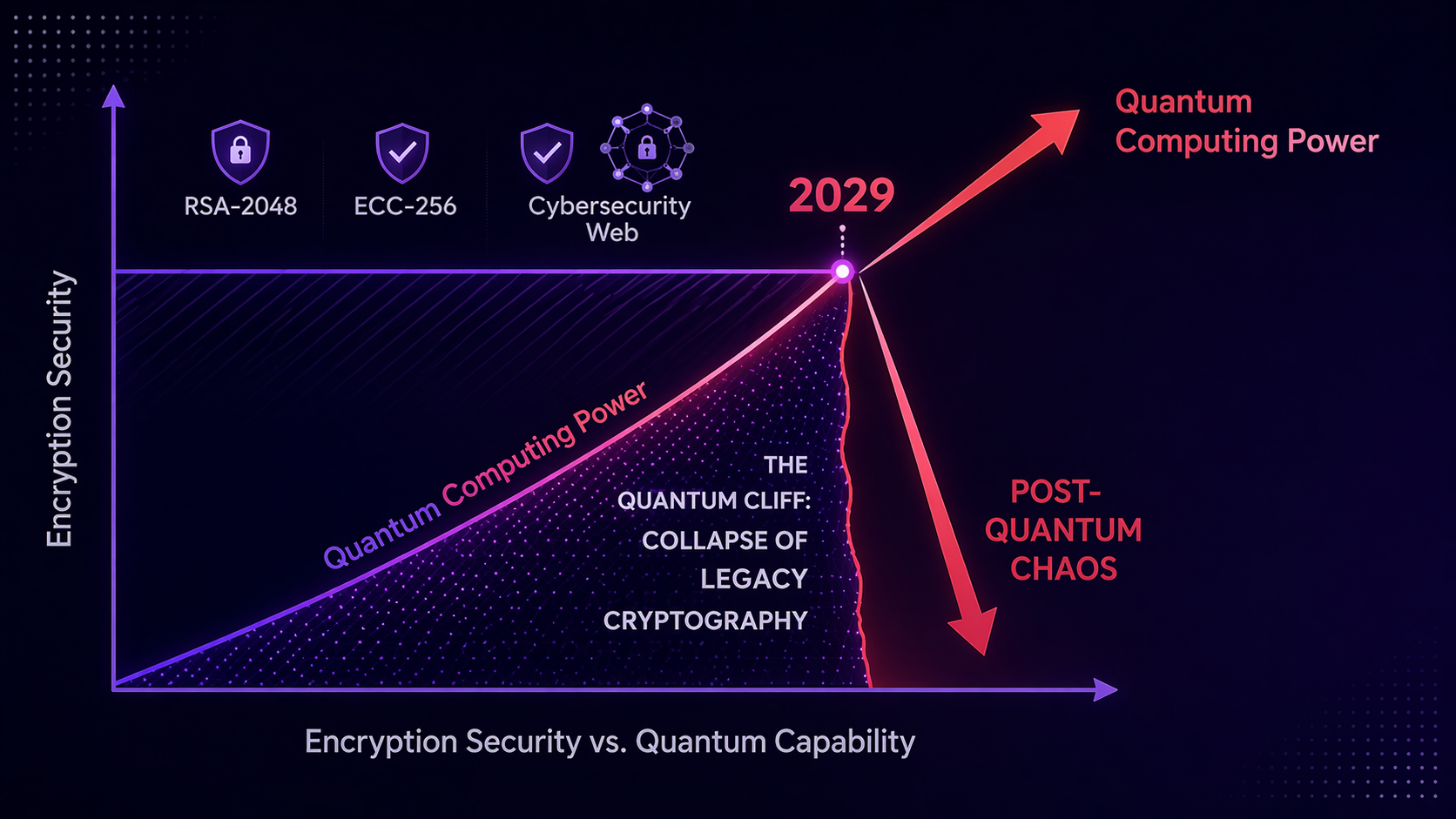
Quantum Cliff is the point at which quantum computing capabilities abruptly render today's encryption methods, like RSA and ECC, obsolete.
Simple Definition
Quantum Cliff is the critical cybersecurity tipping point where quantum computers can break modern encryption fast enough that today's digital security model no longer holds.
Why It Is Called a Cliff
Today: encryption remains secure against practical classical attacks.
Near future: quantum capability grows quietly while legacy systems remain deployed.
Suddenly: encryption fails almost instantly once cryptographically relevant quantum capability arrives.
What Falls Off the Cliff?
Most of today's digital infrastructure depends on public-key encryption systems built around mathematical problems that are extremely difficult for classical computers to solve.
RSA (Rivest-Shamir-Adleman)
Elliptic Curve Cryptography (ECC)
Public Key Infrastructure (PKI)
What Could Break?
Communications
Secure communications can be compromised if the public-key systems protecting sessions and keys become breakable.
Trust
Digital signatures may no longer be trustworthy, weakening software updates, documents, certificates, and transactions.
Authentication
Identity and authentication systems could fail when the cryptographic assumptions underneath them no longer hold.
Financial Systems
Blockchain and financial systems may become vulnerable where they depend on exposed public keys or long-term cryptographic trust.
Quantum Cliff vs Q-Day
| Concept | Meaning |
|---|---|
| Q-Day | The moment quantum computers gain the capability to break widely used encryption. |
| Quantum Cliff | The sudden collapse of security that follows when systems are still dependent on vulnerable encryption. |
Why the Quantum Cliff Matters
Modern society relies heavily on encryption. If encryption fails suddenly, the consequences could be widespread and cross industries almost instantly.
Financial systems and banking transactions could be exposed.
Cloud data and SaaS platforms could be compromised.
Healthcare records may become vulnerable.
Government and defense communications could be intercepted.
Identity and authentication systems may break down.
The Hidden Risk: Harvest Now, Decrypt Later
One of the biggest concerns is a strategy known as Harvest Now, Decrypt Later (HNDL). Attackers can collect encrypted data today, store it, and decrypt it later once quantum computers become capable.
How to Prepare Before the Fall
Preparation must begin well before the Quantum Cliff is reached. Waiting until the cliff arrives leaves too little time for discovery, migration, testing, and deployment.
- Adopt Post-Quantum Cryptography (PQC).
- Follow standards developed by NIST.
- Design systems with crypto-agility so encryption methods can change quickly.
- Identify and protect long-term sensitive data.
- Build a quantum-readiness strategy before the cliff is reached.
Final Thought
The Quantum Cliff is not just a theoretical concept. It is a foreseeable disruption in cybersecurity. The real risk is not only that encryption will break, but that it will break suddenly and without warning.